How to line a pie dish properly
Roll rested pastry to 3 to 4mm thick and about 5cm wider than the dish, lift it in over the rolling pin, then ease it into the corners without stretching before trimming with a small overhang. Stretched pastry snaps back in the oven, so the whole technique is about lowering pastry in slack, never pulling it tight.
By the chickenpie.net test kitchen · Published 22 July 2026
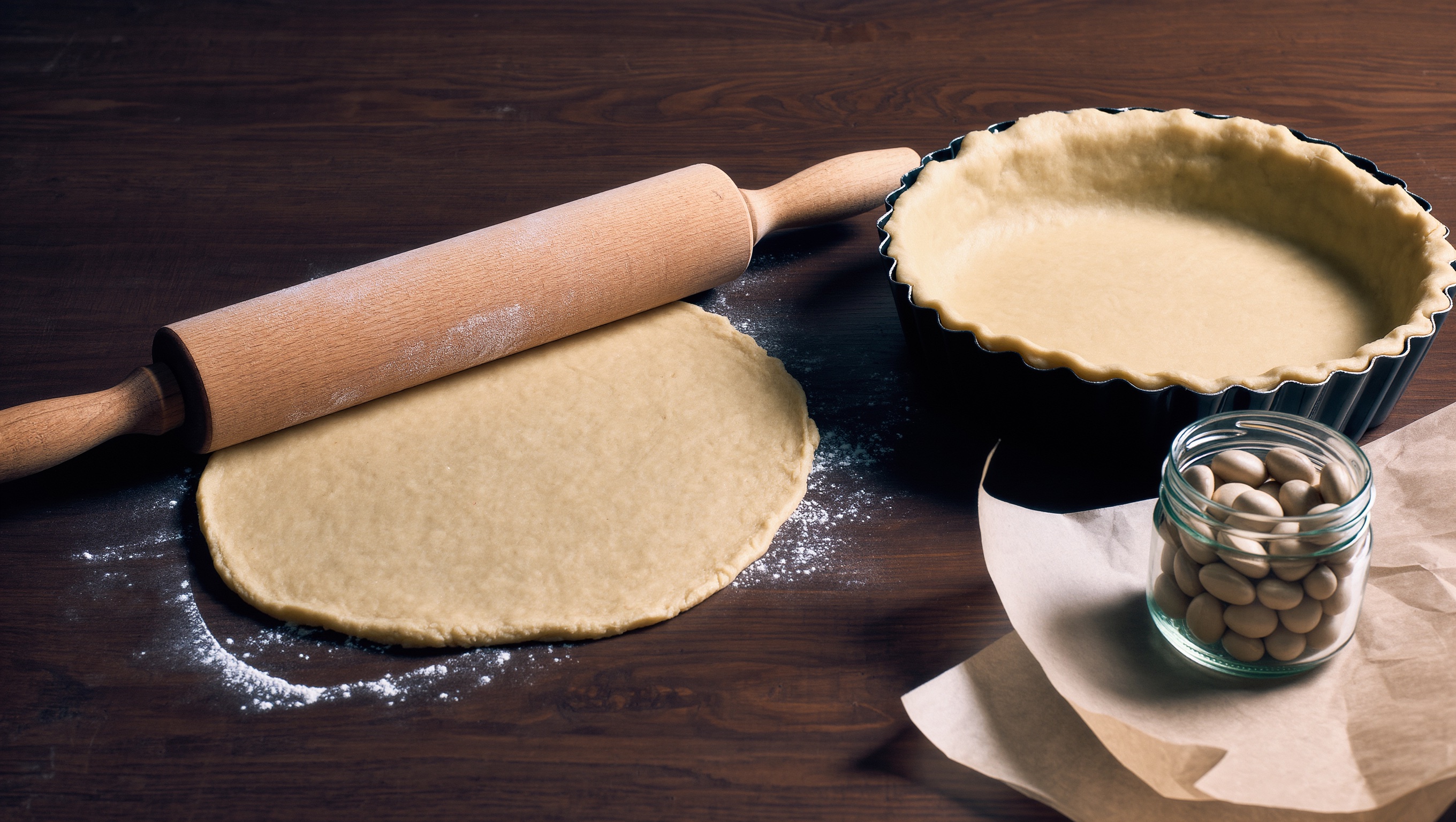
Stretching is the enemy
Pastry has a memory. Whatever tension you put into it during lining gets released in the oven as shrinkage, pulling the walls down and away from the dish. Every step below is really one instruction repeated: move the pastry without stretching it.
Size matters too. Measure your dish across the base, up both sides, and add 4 to 5cm of spare. For a standard 23cm pie dish that means rolling a circle roughly 30cm across. Rolling to size before you start lifting prevents the improvised tugging that causes most problems.
Step by step
Work on a lightly floured surface with pastry straight from its fridge rest, firm but flexible.
- Roll the pastry from the centre outwards, giving it a quarter turn between strokes to keep it round and stop it sticking, until it is 3 to 4mm thick.
- Check the size against your upturned dish, allowing 4 to 5cm extra all round.
- Flour the rolling pin, drape the pastry over it, and lift it across to the dish.
- Unroll it loosely over the dish so it sags into the middle rather than sitting taut across the top.
- Lift the edges with one hand while the other presses the pastry down into the corner where base meets wall. A small ball of spare dough makes a good tamper.
- Press the pastry gently up the sides so it sits flush against the dish everywhere.
- Trim with scissors or a knife, leaving about 1cm of overhang to allow for shrinkage and to give the lid something to seal against.
- Chill the lined dish for 20 to 30 minutes before filling or blind baking.
Repairs and awkward dishes
Tears are not failures. Patch them with a scrap of spare pastry and a dab of water, pressing the seam firmly. A patched base is invisible in the finished pie; a stretched base is not.
Deep dishes and fluted tins need extra slack, so cut the circle wider and let gravity do the placing. In metal tins the pastry grips better and bakes crisper than in ceramic, which is worth knowing if soggy bottoms are a recurring grievance.