From medieval coffyns to the freezer aisle
The chicken pie began as a coffyn, a thick medieval pastry case built for cooking and storage, was already in English recipe collections by around 1390, and reached the freezer aisle in 1951. This is the short version of six centuries.
By the chickenpie.net test kitchen · Published 7 July 2026
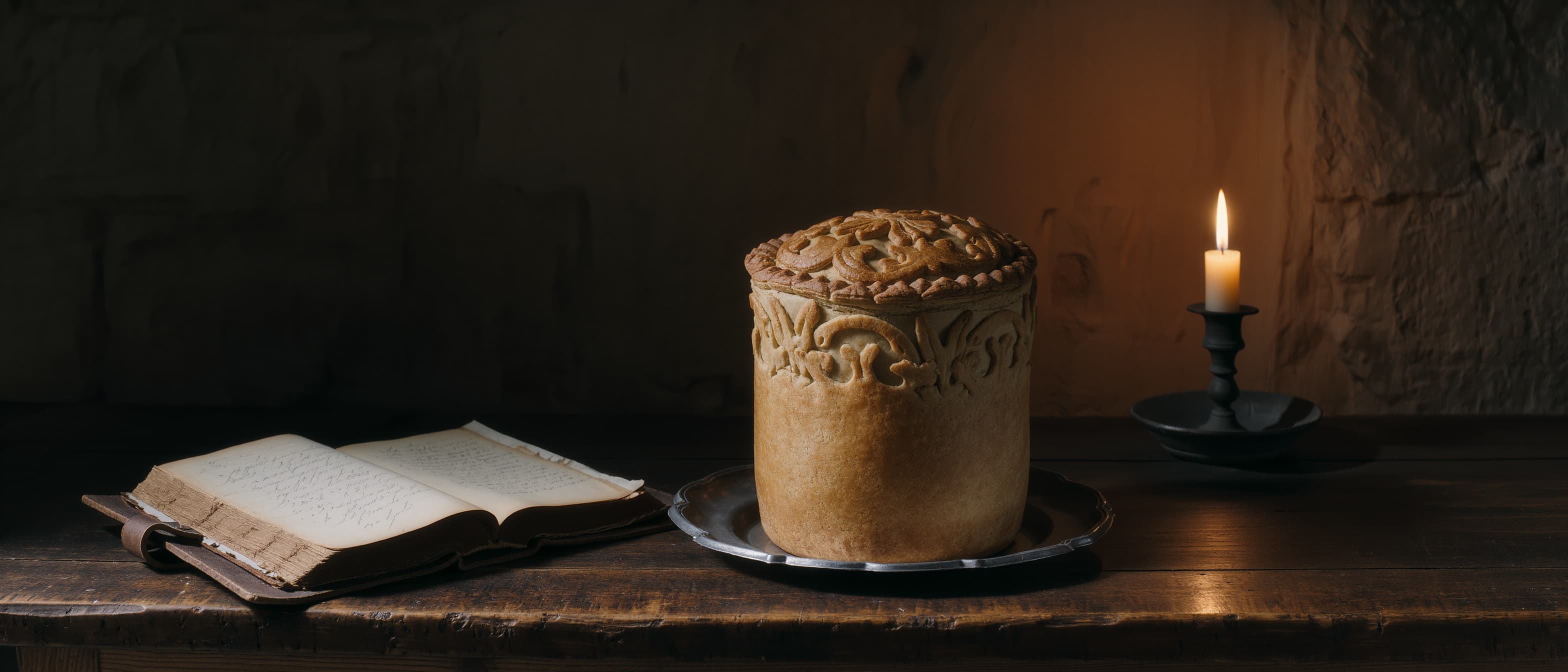
A coffyn was the medieval English name for a thick, free-standing pastry case, and it is where the story of the chicken pie begins. The crust was not really there to be eaten. It was a cooking vessel and a storage container in one: flour, water, and sometimes fat, raised into walls sturdy enough to hold a filling through hours in a wood-fired oven and to seal it afterward.
English recipe collections from the late fourteenth century, including The Forme of Cury, compiled around 1390 by the cooks of Richard II, already describe birds baked in pastry with spices, dried fruit, and wine. A sealed pie kept its contents for days at a time in an age without refrigeration, which made it as much a preservation technology as a dish.
By the Tudor period the pie had become theater. Banquet pies arrived at table gilded, sculpted, and sometimes alive: the nursery rhyme about four and twenty blackbirds records a real party trick, in which live birds were placed under a pre-baked lid to fly out at the cutting. The pie was a way of announcing wealth, and the taller and more architectural the crust, the louder the announcement.
The pie also went to work. A sealed pastry case travels well, needs no plate, and survives a coat pocket, which is why hand pies and pasties became the standard lunch of miners and field workers across Britain. The same logic crossed the Atlantic, where the chicken pot pie settled into American home cooking and, in Pennsylvania Dutch kitchens, lost its crust entirely to become a dish of thick noodles in chicken gravy that still carries the name.
The freezer aisle was the pie's next reinvention. In 1951 the American food company C.A. Swanson and Sons put a frozen chicken pot pie on the market, two years before its television dinner made frozen meals a fixture of the decade. The frozen pot pie turned a banquet centerpiece into a weeknight convenience, and for better and worse it is the version most people alive today met first.
The current chapter runs in the other direction: back toward all-butter pastry, blind-baked bases, and fillings reduced on the stove. That is the version this site is devoted to. The coffyn was engineering, the banquet pie was spectacle, and the frozen pie was convenience. A good chicken pie made at home is all three at once, in reasonable proportions.