The curry puff of Malaysia and Singapore
Malaysia and Singapore · Karipap / epok-epok
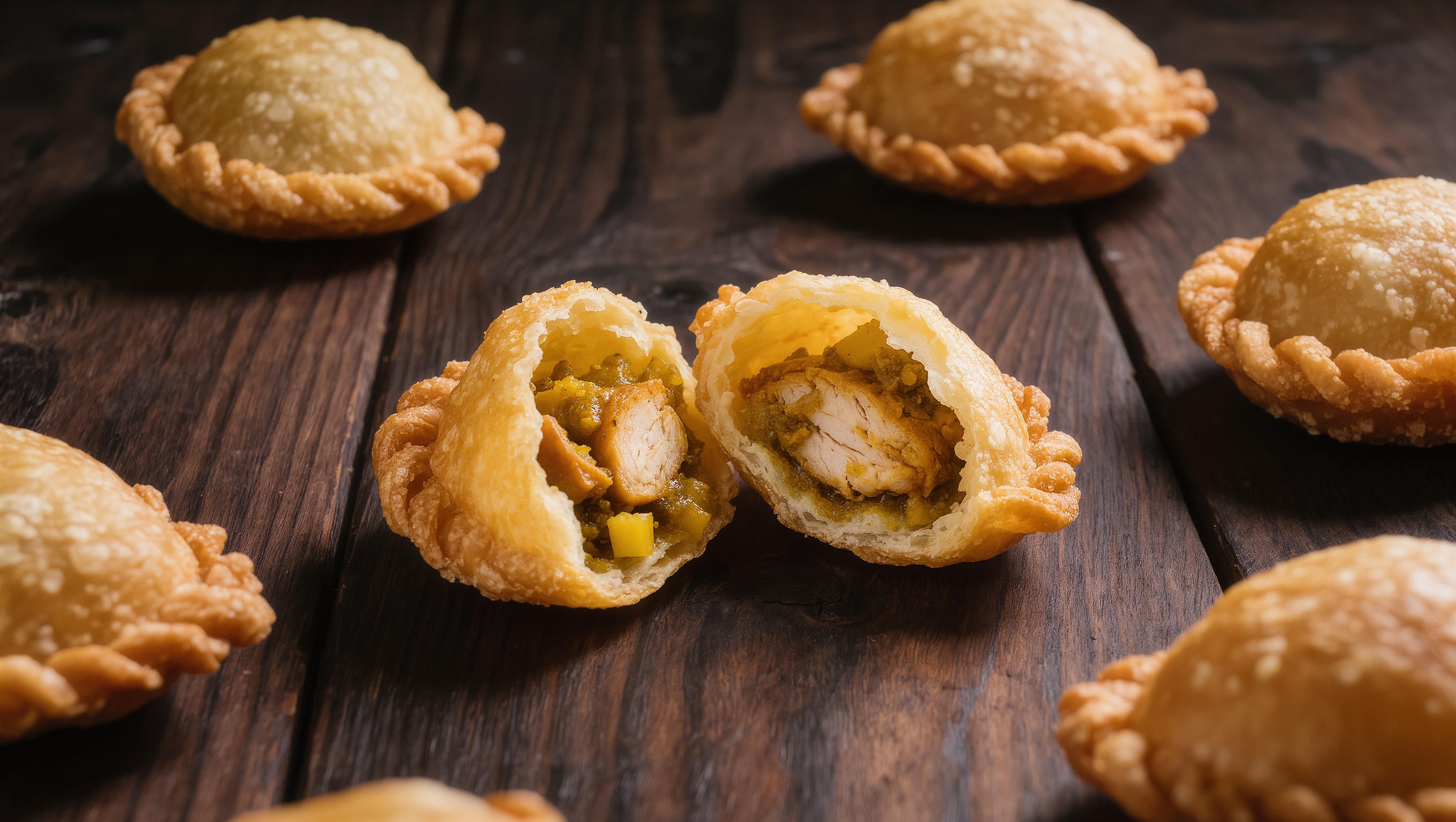
A curry puff is a small deep-fried or baked hand pie from Malaysia and Singapore, filled with curried chicken and potato and often a wedge of hard-boiled egg. Known in Malay as karipap or epok-epok, it is a classic snack sold at markets, roadside stalls, kopitiams, and dedicated curry puff chains.
By the chickenpie.net test kitchen · Published 13 July 2026
Where it comes from
The curry puff is usually explained as a meeting of several pastry traditions in the ports of the Malay Peninsula: the Indian samosa, the British Cornish pasty, and possibly Portuguese-influenced turnovers, all reworked with local curry flavors. Which influence came first is debated, and the snack's exact origin is not documented, so most food writers describe it simply as a colonial-era hybrid.
By the mid twentieth century curry puffs were established street food across Malaya and Singapore, sold by Malay, Indian, and Chinese vendors alike. In Singapore the snack became big business: Old Chang Kee, a stall that grew into a national chain, built its identity on the chicken curry puff, and puffs are now standard fare in food courts and MRT station kiosks. Home cooks also make them for festive spreads, and frozen versions are supermarket staples in both countries. The Singapore curry puff as it is sold today has its own entry.
Regional styles persist. The Malay epok-epok tends to have a thinner, crisper shell, while the spiral-crusted karipap pusing, with its layered rolled pastry, is a marker of skilled makers. Sardine, potato-only, and rendang fillings are common alongside chicken.
How it is traditionally made
Two doughs define the tradition. The everyday version is a simple flour-and-fat dough rolled thin. The spiral version, karipap pusing, layers an oil dough inside a water dough, rolled and coiled so the fried shell shows fine concentric rings, a technique shared with Chinese flaky pastries.
The filling is a dryish curry of diced chicken and potato cooked with onion, garlic, curry powder or a ground spice paste, and often curry leaves, simmered until the potato is tender and the mixture is thick enough to spoon without leaking. Many makers tuck a slice of hard-boiled egg into each puff. The pastry is cut into rounds, filled, folded into a half-moon, and sealed with a rope-like pleated crimp along the edge.
Most curry puffs are deep-fried until golden and blistered, which gives the characteristic crisp shell, though baked puff-pastry versions are now common in modern bakeries; one fondly remembered example was the baked curry puff at a small Bencoolen Street bakery, made with the same butter puff pastry as its chicken pies. They are eaten hot, out of hand, as a snack at almost any hour.
What surprises a British or American cook
Frying is the first difference: the classic curry puff goes into hot oil, not an oven, and the shell is crisp and dry rather than buttery. The filling is a thick, spice-forward curry of small diced chicken and potato with no dairy gravy, sometimes with hard-boiled egg, and the portion is a two-bite to palm-sized snack rather than a meal in a dish.