The Singapore curry puff
Singapore · Curry puff, karipap or epok-epok
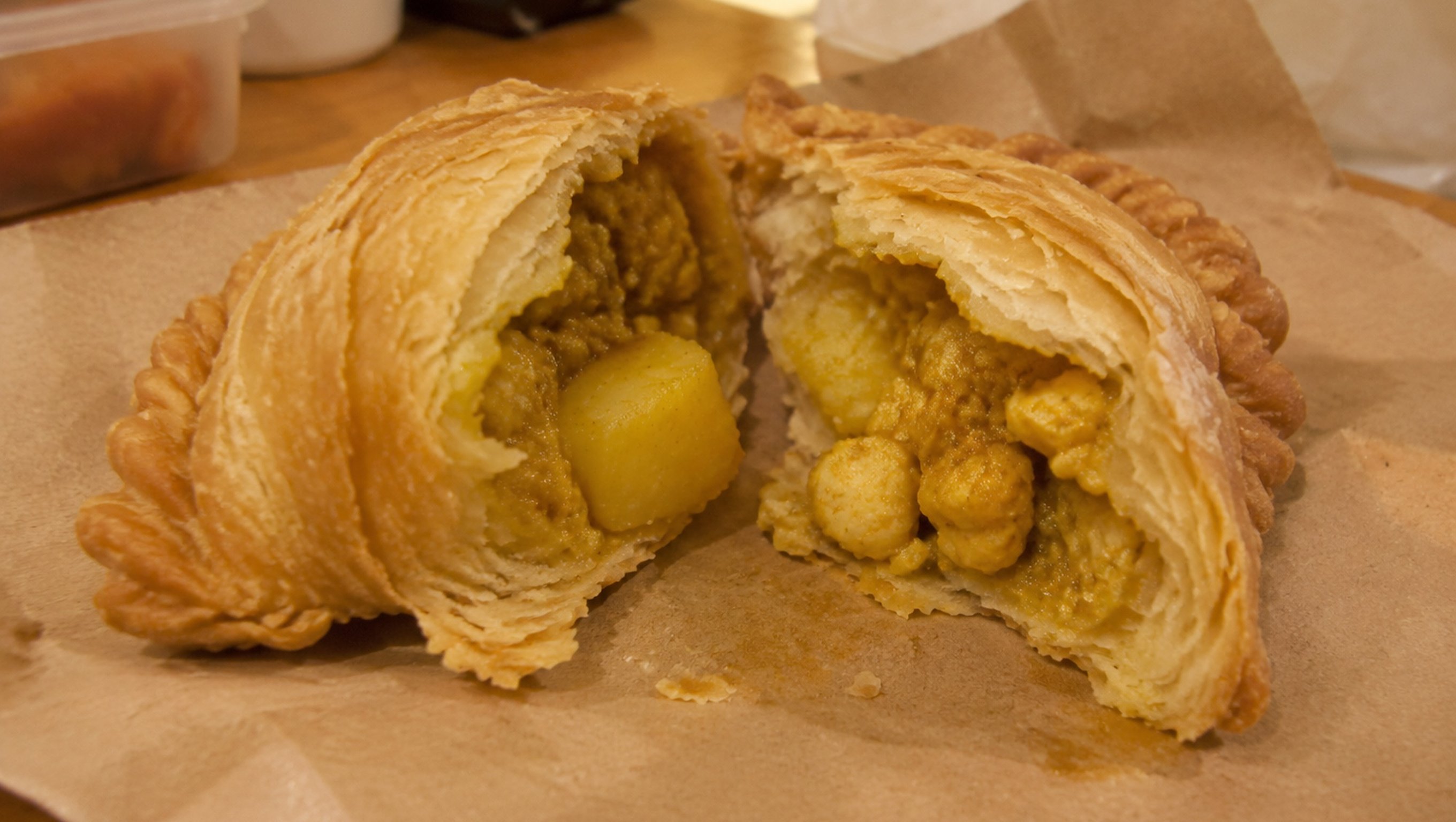
The Singapore curry puff is a half-moon pastry filled with a thick, dry curry of chicken and potato, often with a slice of hard-boiled egg, sealed with a pleated edge and usually deep-fried. Sold by chains, hawker stalls and bakeries, it comes in spiral, plain and baked puff pastry styles and is eaten hot as a snack.
By the chickenpie.net test kitchen · Published 16 September 2026
Where it comes from
The curry puff belongs to the wider Malay world, and its regional history, from the samosa and the Cornish pasty to the spiral-crusted karipap pusing, is covered in the entry on the curry puff of Malaysia and Singapore. This entry is about the curry puff as Singapore eats it today, which has developed its own habits.
In Singapore the curry puff moved early from home kitchens and street hawkers into shops, and from shops into chains. Kiosks selling freshly fried puffs became fixtures at bus interchanges, MRT stations and mall basements, and names such as Old Chang Kee and Tip Top became shorthand for the snack. At the same time bakeries, many of them Hainanese-run, sold baked curry puffs beside their chicken pies, using the same short or flaky pastry and a similar chicken and potato filling with curry powder added.
That shared counter is the key to the Singapore curry puff. It sits between two traditions: the fried Malay and Indian puff with its crisp shell and spice paste, and the baked Hainanese bakery puff that is, in effect, a folded chicken pie. Both are sold side by side, and most Singaporeans eat both without thinking of them as different dishes.
How it is traditionally made
The filling comes first and is deliberately dry. Diced potato and small pieces of chicken are cooked with onion and a curry paste or curry powder, often with curry leaves, sugar and a little evaporated milk or coconut milk, until the potato is soft and the mixture is thick enough to hold its shape on a spoon. It must be cold before it is wrapped; a warm filling tears thin pastry.
Three pastries are common. The plain fried puff uses a simple dough of flour, fat and water, rolled thin. The spiral puff layers a water dough and an oil dough, rolls and coils them, and cuts across the coil so the fried shell shows fine rings. The baked bakery puff uses short or puff pastry, glazed with egg, and has a softer, more buttery shell.
Rounds of pastry are filled, often with a sliver of hard-boiled egg on top of the curry, folded into a half-moon, and sealed with a rope-like pleat pinched along the edge. Fried puffs go into oil at a moderate temperature so the pastry blisters and cooks through before it colours; baked puffs go into a hot oven until golden. Both are best eaten within an hour or two of cooking.
What surprises a British or American cook
Next to a Hainanese chicken pie the curry puff is drier, spicier and portable in a different way: folded rather than tinned, usually fried rather than baked, with the filling held by its own thickness rather than a pastry base and lid. Next to a British pasty it is smaller, sweeter in its spicing, and much more often fried. What surprises a Western cook most is how dry the filling is; there is no sauce to speak of, which is why the shell stays crisp.
Curry puff or chicken pie?
The two share a filling family, chicken and potato with pepper or curry, and often the egg, but differ in almost every technical choice: shape, pastry, cooking method and moisture. A side-by-side comparison of chicken pie and curry puff sets out the differences in pastry, filling and portion. For the pie side of the family, see the Singapore Hainanese chicken pie.
Fillings beyond chicken
Chicken and potato is the default, but Singapore counters carry a rotating cast: sardine in a tomato and chilli sauce, potato-only for vegetarians, black pepper chicken, and seasonal or festive specials. The egg is optional and divides opinion; some makers put a slice in every puff, others only in a premium version. Whatever the filling, the rule is the same: thick enough to stand on a spoon, so the shell fries crisp instead of steaming from the inside.
The baked puff pastry curry puff
Baked curry puffs made with butter puff pastry are the bakery branch of the family, and some of the best remembered came from small bakeries that made their pastry in-house. If you want to try one at home, a baked puff pastry curry puff recipe written for a warm kitchen covers the pastry handling as well as the filling. Keep the filling cold, the pastry colder, and bake on a preheated tray so the base cooks before the lid over-browns.
Where it fits among Singapore's pies
Visitors often ask whether a curry puff counts as a pie. In Singapore it is filed with the snacks rather than the pies, but it is part of the same baked and fried pastry culture as the chicken pie, the British-style meat pie and the Australian pie that arrived later. A guide to Singapore, British and Australian pie types places it in that wider family. At home, the curried chicken hand pies on this site use a related filling in shortcrust.
Reheating curry puffs
Fried curry puffs soften as they cool. Reheat them in an air fryer at 160C (320F) for 4 to 6 minutes or a toaster oven at 170C (340F) for 6 to 8 minutes, until the centre is steaming hot, 74C (165F). The microwave makes the shell leathery. The same rules as for reheating a chicken pie Singapore-style apply to storage: into the fridge within 2 hours, sooner on a hot day.